
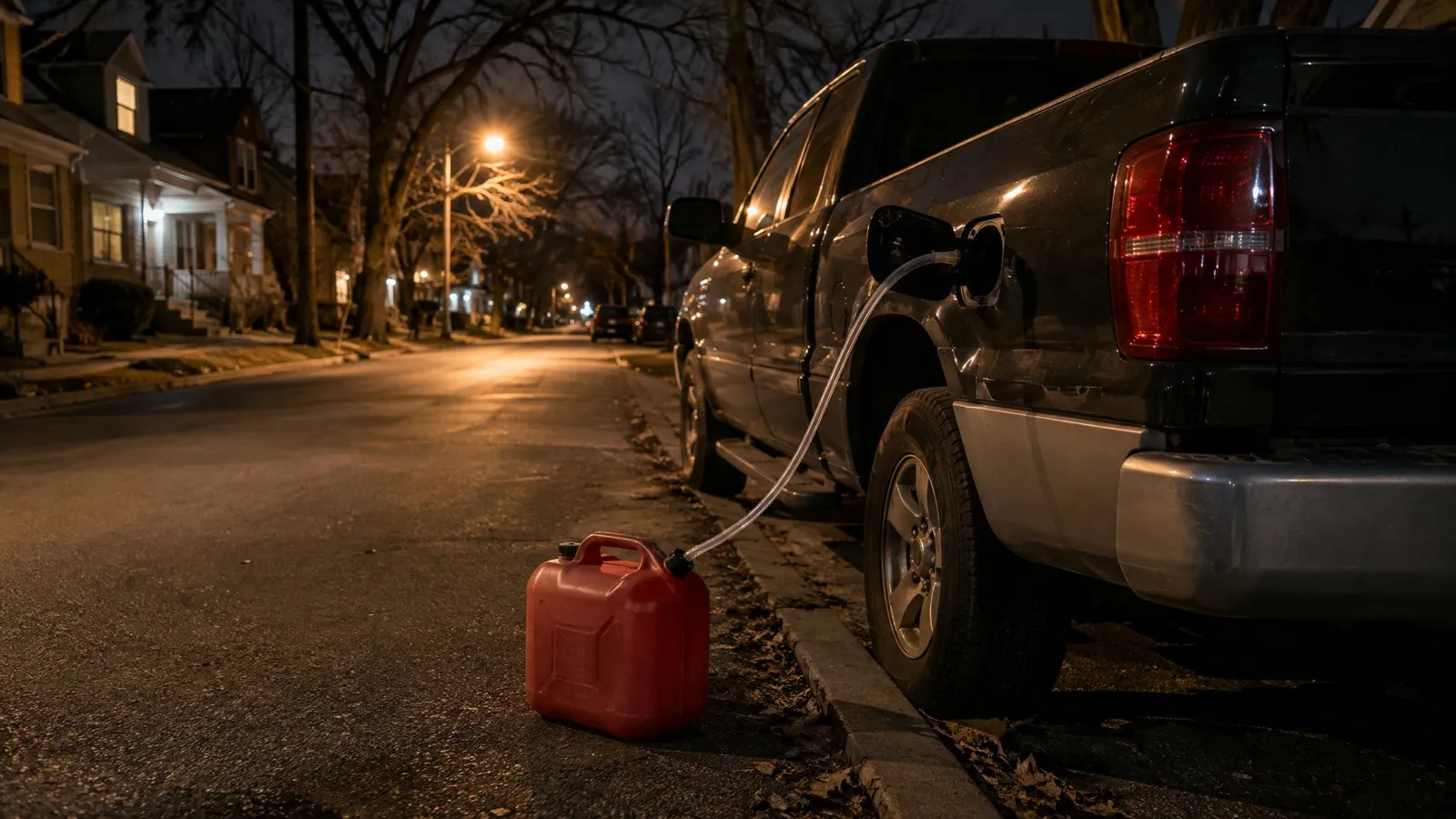
Illustration for this story, not a photo of the incident.
Quick answer
As of September 23, 2026, the Lincoln Police Department said it was investigating 12 fuel theft or fuel tank damage cases for the year, four of them siphoning or attempted siphoning, with about $6,350 in repairs and more than $600 in stolen gas across all cases (KFOR, KLIN). Every siphoning job begins at a fuel door that opens with a push.
The Four Siphoning Reports
Police listed these siphoning or attempted siphoning cases in 2026:
- January 15 — 4900 block of North 57th Street
- April 22 — 1025 North 63rd Street
- July 31 — 2200 block of Wildcat Circle
- August 17 — 1500 block of South 2nd Street
Spread Out, Not Concentrated
LPD public information manager Erika Thomas said the cases are scattered around Lincoln rather than clustered in one neighborhood, and police don’t know whether one person or group is responsible. The other eight cases on the list involved damaged fuel tanks — the kind of repair that often costs far more than the fuel itself.
How Siphoning Actually Happens
It’s the oldest, quietest way to steal fuel. Someone opens the fuel door, removes the cap, and feeds a hose or small battery pump down the filler neck into a can. It takes minutes, makes almost no noise, and is usually done overnight. Most owners don’t notice until the gauge reads low.
The same method scales up: a Ventura County crew siphoned about 385 gallons from commercial trucks, and B.C. thieves drained construction machines into portable tanks.
The Fuel Door Is the Weak Point
Factory fuel doors push open, and standard caps twist off by hand. A locking cap helps a little, but it’s still out in the open where it can be pried or snapped. A bolt-on locking fuel door covers the cap and filler neck behind a keyed, armored door — no access means nowhere to put the hose. That’s true for a pickup on a city street and for a motorhome parked in the driveway.
Protect Your Vehicle From Siphoning
- Cover the filler with a locking fuel door.
- Park fuel side toward a wall, fence or another vehicle.
- Use motion lighting and a camera that sees the fuel side.
- Note your fuel level when you park and check it in the morning.
- Report every case, even small ones. In Lincoln, call 402-441-6000, or Crime Stoppers anonymously at 402-475-3600.
Key Takeaways
- Lincoln Police reported four siphoning or attempted siphoning cases among 12 fuel cases in 2026 (KFOR, KLIN).
- About $6,350 in repairs and more than $600 in stolen gas across all 12 cases.
- Cases were spread across the city, not concentrated in one area.
- Siphoning starts at an easy-to-open fuel door — cover it.
Frequently Asked Questions
How many gas siphoning cases has Lincoln Police reported in 2026?
As of September 23, 2026, police were investigating 12 fuel theft or tank damage cases, four involving siphoning or attempted siphoning: January 15, April 22, July 31 and August 17.
How much have these cases cost?
Police estimated about $6,350 in repair costs and more than $600 in stolen gasoline across all 12 cases.
Who should Lincoln residents call?
Lincoln Police at 402-441-6000, or Crime Stoppers anonymously at 402-475-3600, especially with home surveillance footage.
Take the Cap Out of Reach
THE FUEL VAULT™ is a bolt-on locking fuel door that covers your exposed fuel cap behind a keyed, armored door. No drilling, installs with hand tools, Limited Lifetime Warranty, made in Sarasota, Florida. Questions? Call 941-732-0452.
Sources
- KFOR, “LPD investigating reports of gas siphoning, fuel tanks damaged across Lincoln” (opens in a new tab), September 23, 2026.
- KLIN, “Lincoln Police investigate 12 fuel tank damage and siphoning cases” (opens in a new tab), September 23, 2026.
Summarized and rewritten by Fuel Vault from the reports above. Anyone arrested or charged is presumed innocent unless proven guilty in court.